
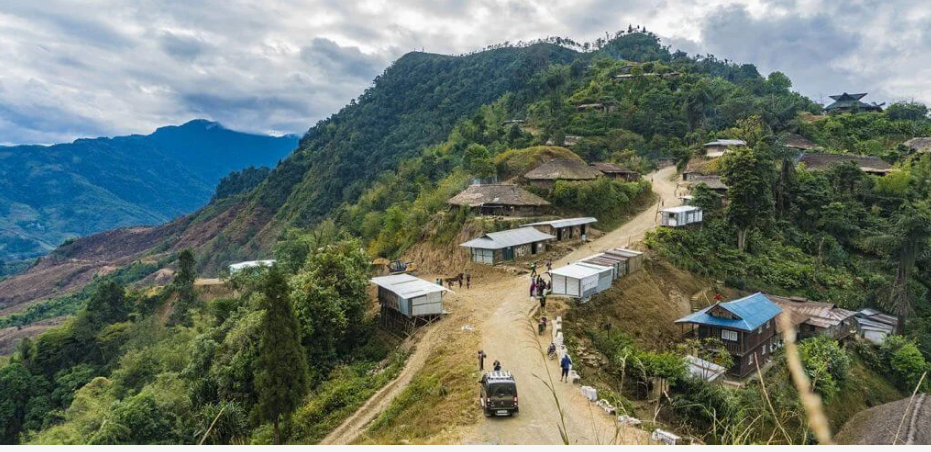
In Longwa Village, located in Nagaland, India, there is a unique chief’s house (the Angh’s house) that sits directly on the international border between India and Myanmar, with one half of the house in India and the other half in Myanmar.
Longwa Village, found in the Mon district of Nagaland in northeastern India, is known for one of the most remarkable geographical curiosities in the region. The village lies directly on the boundary between India and Myanmar, but what makes it truly extraordinary is the house of the local chief, known as the Angh. This traditional, historic house is physically split by the international border: one part stands within the territory of India, while the other extends into Myanmar. As a result, the Angh and his family live in a home that belongs to two different countries at the same time, making it a unique symbol of both cultural unity and geographical complexity.
The existence of such a house highlights the nature of borders in tribal regions where historical settlements existed long before modern political boundaries were drawn. The Konyak people, the main tribe inhabiting Longwa, traditionally moved and settled freely across the hills without regard for national lines. When the India–Myanmar border was officially established, it cut directly across their land, leaving families, farmland, and even homes divided by the new boundary. Because of this, the border in Longwa is not a strict barrier but rather a line that crosses naturally through the everyday lives of the villagers.
This geographical feature also demonstrates the deep cultural continuity between the Konyaks of India and Myanmar. Despite belonging to two different nations, the communities share the same language, customs, and traditions. The Angh himself has symbolic authority over villages located on both sides of the border, reflecting the tribal leadership that predates colonial or national boundaries. Visitors often find it fascinating that they can stand in the Angh’s house with one foot in India and the other in Myanmar, illustrating how geopolitical lines can intersect with human life in unexpected ways.
Ultimately, the border house of Longwa Village is not only a geographical phenomenon but also a powerful reminder of how history, culture, and geography shape communities. It reveals how modern borders sometimes divide what was once a single cultural region and how people continue to adapt their lives around these divisions. The Longwa house remains one of the most well-known and visually striking examples of a physical structure that literally crosses a national boundary, making it an important geographical and anthropological point of interest.
Author: Jean de Dieu IRAFASHA
The House That Stands in Two Countries DEEPLY RESEARCH IJD
Amazing Geographical Fact
Amazing Geographical Fact



Comments
Amazing
Sure 🤔🤔🤔 It means that they have two nationalty
One village in Two countries 🫨🫨🫨🫨
Amazing