
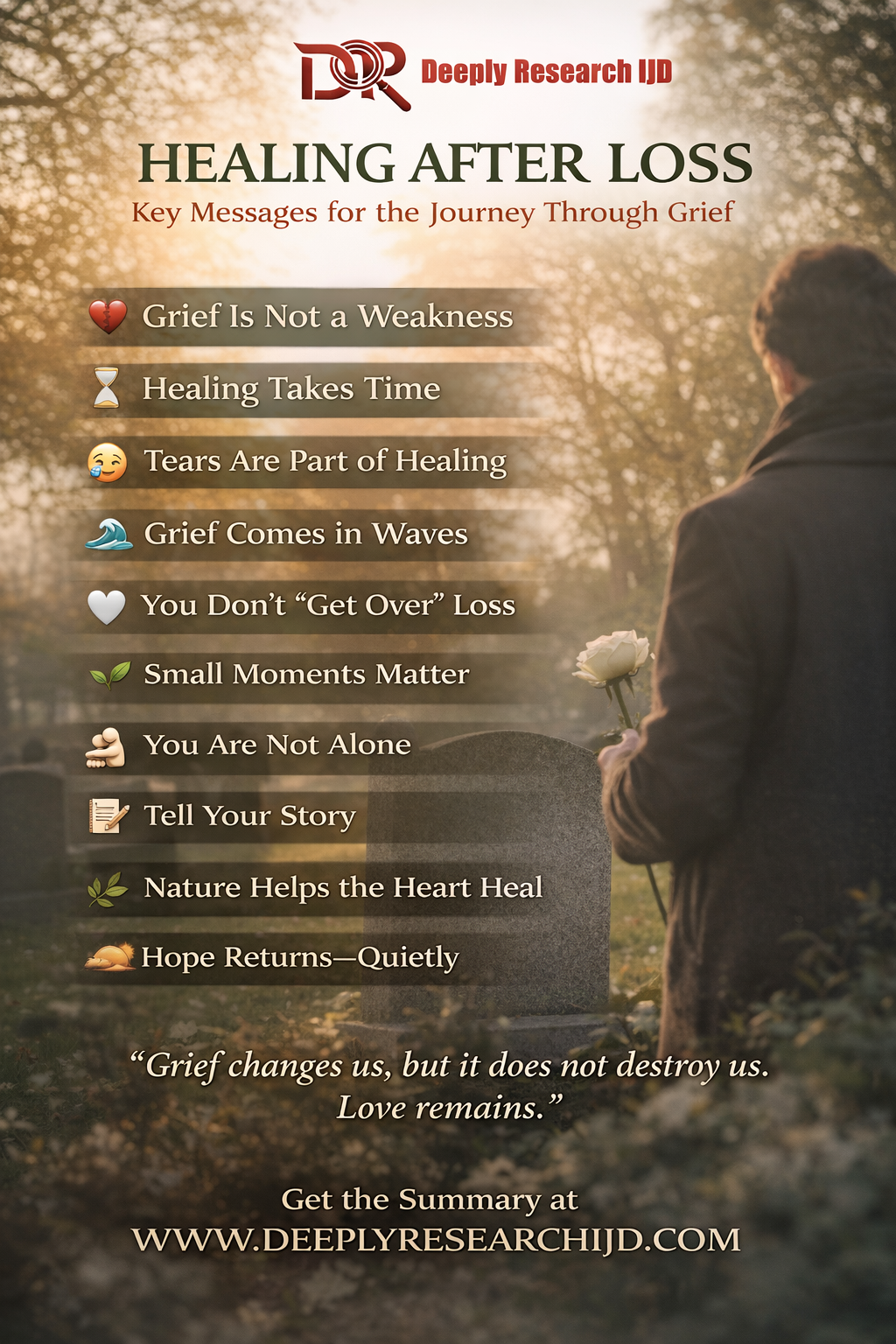
Martha Whitmore Hickman’s Healing After Loss is a deeply compassionate and spiritually grounded book designed to accompany people through the long, uneven journey of grief. Rather than presenting grief as a problem to be solved or an experience to “get over,” Hickman treats loss as a sacred human passage one that reshapes identity, relationships, time, and meaning. Structured as daily meditations across the calendar year, the book offers brief reflections, quotations, and prayers that acknowledge the pain of loss while gently guiding the reader toward healing, resilience, and renewed engagement with life.
1. The Nature of Grief: A Long and Sacred Process
A central message of the book is that grief is not short-lived nor linear. Hickman emphasizes that the death of a loved one especially a spouse, child, or deeply significant figure is not something one simply recovers from in weeks or months. Instead, grief unfolds over years, sometimes for a lifetime. Certain losses are never fully resolved, but they can be integrated into a person’s life in a way that no longer dominates or controls them.
The author rejects cultural pressures that encourage mourners to “move on” quickly. She insists that grief cannot be rushed or bypassed without consequences. Attempts to suppress pain, deny sorrow, or maintain emotional control may delay healing and deepen suffering. Grief demands attention, honesty, and patience. When it is respected as a process, it slowly transforms from overwhelming pain into something more manageable often accompanied by gratitude, memory, and love.
2. Tenderness, Vulnerability, and Emotional Honesty
Hickman describes grief as a time of profound vulnerability. The bereaved are emotionally exposed; ordinary experiences sounds, gestures, places can unexpectedly reopen wounds. She normalizes this sensitivity and presents it not as weakness, but as a natural response to love and loss.
The book strongly encourages emotional honesty, especially the freedom to cry. Hickman draws on psychological and physiological insights to show that tears are not only emotionally healing but physically beneficial. Crying releases stress, relieves emotional pressure, and allows grief to move rather than stagnate. Suppressing tears out of embarrassment or fear of burdening others only prolongs suffering.
Grief, according to Hickman, requires permission: permission to mourn, to feel anger, confusion, despair, longing, and even moments of relief or laughter without guilt. Healing begins when mourners stop judging their emotions and allow themselves to experience grief fully.
3. Time, Memory, and the Rhythm of Healing
Another key theme is the relationship between time and memory. Hickman explains that the mind initially grasps loss only in vague, overwhelming terms. It takes months or years for memory to absorb the full reality of what has been lost. This slow process explains why grief often resurges unexpectedly long after the death.
Over time, however, something changes. Painful memories gradually soften and transform into treasured recollections. The same images that once caused unbearable sorrow a laugh, a gesture, a shared habit can later bring warmth and gratitude. This does not mean the loss disappears; rather, memory shifts from being dominated by absence to being enriched by love.
Importantly, Hickman encourages readers to live one moment at a time. Instead of fearing a future filled with absence, mourners are invited to savor small, good moments a walk, a conversation, a cup of tea. Healing occurs in moments, not grand leaps.
4. The Danger of Clinging to Grief
One of the book’s most insightful contributions is its discussion of how grief itself can become something people unconsciously cling to. Hickman acknowledges that intense mourning can feel like the last remaining connection to the person who died. Letting go of grief may feel like betrayal.
However, she gently challenges this idea. Grief is not the loved one. Holding onto pain does not preserve the relationship. In fact, remaining stuck in grief can trap the mourner at the moment of death rather than honoring the fullness of the loved one’s life. True healing allows memory to expand beyond the moment of loss and reconnect with the joy, meaning, and shared history that existed before death.
5. A New Relationship with the Dead
Rather than encouraging detachment, Hickman introduces the idea of forming a new relationship with the deceased. This relationship is not physical, but emotional and spiritual. It develops slowly and often silently. As grief loosens its grip, many people experience a renewed sense of connection through memory, inner dialogue, dreams, or a sense of presence.
This evolving bond does not deny reality; it accepts death while affirming that love continues. Hickman reassures readers that healing does not mean forgetting. On the contrary, healing often deepens remembrance and allows the loved one’s influence to live on through values, actions, and compassion.
6. Community, Companionship, and Shared Grief
Hickman repeatedly stresses that healing is impossible in isolation. While solitude has its place, prolonged withdrawal from others intensifies loneliness and despair. Grief is inherently individual, yet it is also universal. Connection with others especially those who have experienced similar losses offers validation, understanding, and hope.
The book highlights the power of grief communities, friendships formed through shared sorrow, and simple companionship. Often, people who have suffered loss recognize one another immediately, without explanation. These relationships can be deeply supportive and enduring.
At the same time, Hickman acknowledges the tension that arises when friends or family do not know how to respond to grief. She encourages honesty naming sadness, asking for company, and gently guiding others in how to be present.
7. Storytelling as Healing
Telling one’s story is presented as both a responsibility and a gift. Hickman argues that survivors have a duty not only to themselves but to others to share how they endured loss. Speaking about the loved one affirms their life. Sharing one’s own grief journey helps others who will inevitably face loss in the future.
Writing, journaling, art, and conversation are all offered as tools for releasing grief from the heart and placing it somewhere tangible. Hickman shares her own experience of writing extensively after the death of her daughter, describing it as a way to siphon grief away and regain emotional balance.
8. Physical Movement, Nature, and the Body
Grief is not only emotional; it is deeply physical. Hickman emphasizes the healing power of movement and nature. Walking, exercise, breathing, and being outdoors help release emotional energy stored in the body. Physical activity restores a sense of agency and competence at a time when life feels out of control.
Nature also offers comfort and perspective. The cycles of seasons, the resilience of the earth, and the ongoing rhythms of creation suggest continuity beyond individual loss. While nature does not erase pain, it reminds mourners that life continues and renewal is possible.
9. Faith, Meaning, and Spiritual Trust
Although grounded in Christian spirituality, the book speaks broadly to spiritual seekers. Hickman does not claim that faith eliminates grief or explains suffering. Instead, faith is presented as presence the belief that God or a larger love accompanies people in their pain.
Rather than asking why loss occurred, Hickman invites readers to trust that they are held, seen, and cared for, even when answers are absent. Comfort comes not from explanations, but from companionship divine and human.
10. Growth, Wisdom, and Reclaiming Life
In its later reflections, Healing After Loss explores the possibility of growth through sorrow. Hickman is careful not to romanticize suffering. She acknowledges that wisdom gained through grief is costly and never chosen. Yet she affirms that those who endure loss often emerge with deeper compassion, clarity about what matters, and heightened appreciation for life.
Healing eventually allows mourners to laugh again, invest in new projects, rediscover old passions, and help others through similar pain. The goal is not to erase grief, but to reclaim life while carrying love forward.
Conclusion
Healing After Loss is not a manual for curing grief but a gentle companion for those walking through it. Martha Whitmore Hickman honors grief as an expression of love and a testament to human connection. Through daily meditations, she offers reassurance that sorrow can be survived, that love endures beyond death, and that life though changed can be meaningful again. The book affirms that healing is not forgetting, but remembering with gratitude, strength, and renewed hope.
📄 Open PDF (1769711025_content_2_Healing_After_Loss_-_Martha_Whitmore_Hickman.pdf)



Comments
😥😥😥😥😥😥 my mom
😢